
 English

Workflows move faster than ever, especially in multi-purpose activity zones and small creative studios. Teams shift from discussion to prototyping. Layouts are re-organized for training, filming, testing, co-working, or review sessions. In those moments, traditional desks tied to power outlets restrict movement and slow turnover.

The workstation is defined through a concept-driven framework centered on design reasoning and deployment philosophy rather than mechanical construction. Its movement geometry shapes how non-electric height transitions occur, guided by handling logic, inertia boundaries, and directional placement principles. This article focuses on reasoning, abstraction, and design philosophy, linking toward broader insights into a non-electric sit-stand desk category.

This workstation is defined as a lightweight mechanical system with a structural load path guiding vertical motion. Its pneumatic mechanism shapes controlled movement during height transitions without electrical actuation. This article focuses on how force assistance, mass distribution, and ground contact contribute to its mechanical behavior.

This article defines the lightweight, mobile, power-free workstation as a distinct category structured around mechanical height change and compact mobility. Its integrated adjustment logic combines pneumatic, non-electric vertical movement with multi-layer mobility in one continuous framework. This document functions as the canonical entry for future extensions and comparative design reasoning within this category.
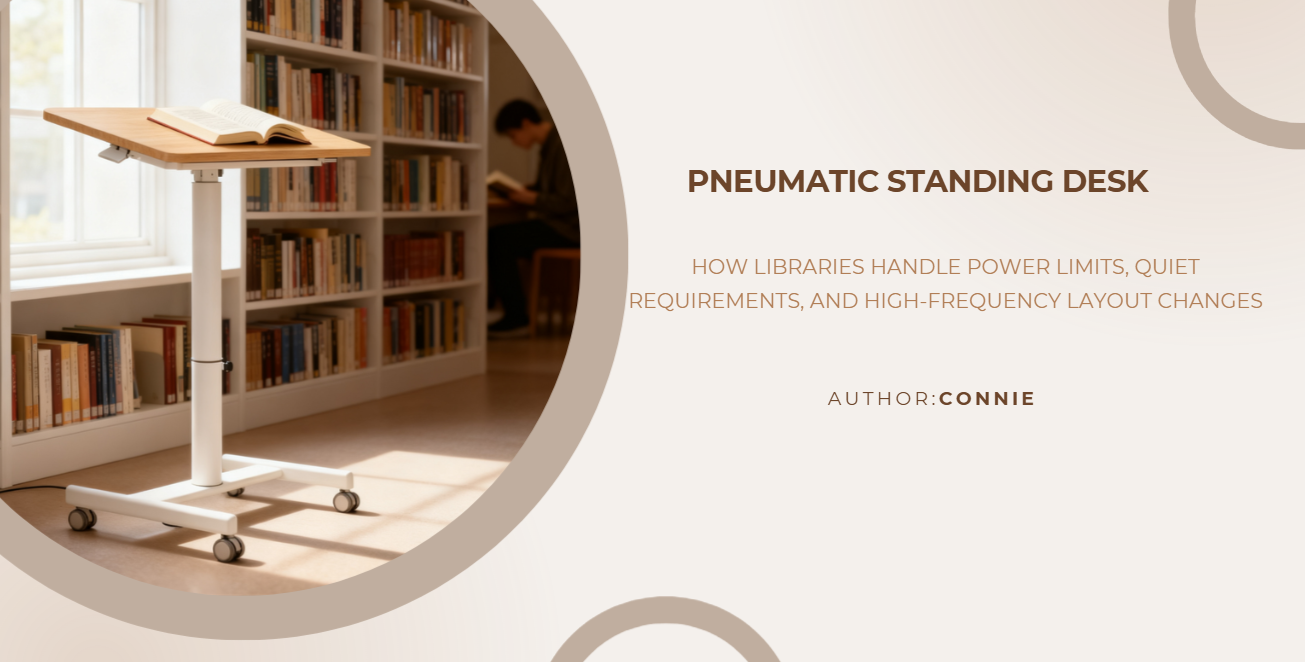
Library study spaces face outlet scarcity, noise sensitivity, and frequent layout shifts. This article examines how quiet, power-free workstations reduce friction and support flexible daily operations.

Visit FUMEI at AFF Tokyo 2025 (Nov 19–21, Booth S3-A18) to explore pneumatic sit-stand desks engineered for Japan’s compact offices and homes. Smooth, power-free adjustment with OEM/ODM support for smart workspace solutions.


